FrequentlY Asked
FAQs
Cost depends on size, style, finish, and fittings. As a guide: single painted floating shelves start around £265 each, low-level alcove cabinets from £765 per unit supply-and-fit, and a fully spray-painted pair of cabinets with floating shelves above typically falls in the £2,500–£4,000 range. Full-height Victorian units, alcove wardrobes, and wide dressers price higher. See our alcove unit pricing page for example project costs across all our core services, or contact us for a firm quote on your space.
For a pair of low-level alcove cabinets either side of a chimney breast with floating shelves above start as from £2,500. A recent Forest Gate E7 project included — two handmade two-door Victorian alcove cabinets at £765 each supply-and-fit, spray painting at £420 per unit, and six solid floating shelves on hidden rails at £265 each. Full-height Victorian units and alcove wardrobes price higher, and single units are priced individually.
Painted MDF is both the standard choice and the more cost-effective option for alcove cabinets, cupboards, and painted floating shelves. It machines cleanly for panel mouldings, stays stable through seasonal humidity changes, and takes a spray finish beautifully. Solid wood is priced higher and recommended where the grain will actually be seen — oiled or waxed floating shelves, dresser tops, or bookcase faces — rather than for painted cabinetry where you're paying extra for a material you then cover up. See our prices page for the price difference between painted and solid-wood shelves.
No — our quoted prices are the same whether you're in Leytonstone, Walthamstow, Wanstead, Hackney, or anywhere else in our core 30-minute service area from our Leytonstone workshop. Travel is built into our standard rates for this zone, and all example prices on our alcove unit pricing page apply across this area. For jobs further afield we'll note any additional travel separately when we quote. See our East London coverage for the full list of areas.
No — both are free. For most alcove cabinets, cupboards, and shelves we can provide a firm quote by email within a couple of working days if you send the width, depth, and height of each alcove plus a few photos. For larger projects, trickier spaces, or where you'd like design input, we'll visit you in East London for a free home consultation with no obligation. For a sense of what your project might cost before you get in touch, see our alcove unit pricing page, or contact us directly to start.
We replicate the exact moulding profile on-site using templates, then mill matching ogee, bead, or ovolo profiles in our workshop so new cabinets and cupboards sit flush with your existing architraves and skirting. See examples in our alcove cabinets gallery.
Yes. Our standard terms are a deposit to confirm your booking and lock in your build slot in the workshop, with the balance payable on completion once you've seen the installation in your home. For larger projects spanning multiple rooms, we can split the balance across a mid-project stage too. Payment terms are always confirmed in writing alongside your quote so there are no surprises.
A low-level alcove unit is a half-height cabinet — typically 800–900mm tall — that sits inside the alcove next to a chimney breast. A pair either side of the breast usually supports a TV on top, with floating shelves mounted on the wall above. It's the most popular alcove cabinet format we build for East London living rooms.
400–450mm is our standard depth for alcove cabinets and cupboards — enough for a Sky box, router, or Sonos speaker, but not so deep the unit protrudes past a chimney breast. We customise depths to your exact space. See our alcove cabinets page for more on typical dimensions.
Yes — most of our Victorian alcove projects are designed around a central chimney breast, with cabinets or cupboards filling the flanking alcoves. We scribe the sides to take up any irregularities in the original brickwork, giving a seamless fit. Browse our alcove units hub for more examples.
800–900mm is our standard low-level alcove cabinet height — tall enough for useful storage inside, low enough that a TV sits at a comfortable viewing height above. We adjust the exact height to match existing skirting, align with a chimney breast ledge where one exists, or sit flush with a mantel.
A full-height alcove cupboard runs from the floor to the ceiling (or just under coving) and maximises storage — our preferred format for bedrooms, home offices, and rooms without a TV. A low-level alcove cabinet is roughly half-height with open floating shelves above, better suited to a living room or TV snug where you want to keep the room feeling open.
We routinely colour-match Farrow & Ball, Little Greene, and Dulux heritage ranges on alcove cabinets, cupboards, and shelving. Deep greens like Green Smoke and Card Room Green, off-whites such as Slipper Satin and School House White, and dark blues like Hague Blue are popular choices in East London Victorian homes. Send us a swatch and we'll match it exactly.
Yes — low-level alcove cabinets are designed to support a TV directly on top. We reinforce the top panel and route cable management channels so power, HDMI, and aerial cables run discreetly inside the cabinet. For a wall-mounted TV above a pair of low-level units, see our built-in TV units for swing-arm mounting options on the chimney breast above.
We stop full-height alcove cupboards just below the original coving to preserve the period detail, typically finishing the top of the unit with a matching cornice so it reads as part of the architecture. For rooms without coving, we can run the cupboard all the way to the ceiling with a small scribed trim to absorb any ceiling undulations.
From initial consultation to installation, typically 4–6 weeks for alcove cabinets, cupboards, or shelving. The on-site install itself is usually completed in one to two days with minimal disruption to your home. Start with a free consultation via our contact page.
Yes — we build alcove units for both, and the approach is almost identical. Victorian and Edwardian homes across East London share the same basic layout of alcoves flanking a central chimney breast, but Edwardian properties often have slightly wider alcoves, taller ceilings, and simpler moulding profiles. We match any plate rails, picture rails, or coving profiles specific to your period.
We're based in Leytonstone and our core service area covers roughly a 30-minute drive from our workshop — Leytonstone, Leyton, Walthamstow, Wanstead, Forest Gate, Woodford, Snaresbrook, South Woodford, Highams Park, and Manor Park. We also regularly work further west across Hackney, Stoke Newington, Clapton, and Dalston. See our full East London carpenter and North East London coverage.
Internal fitted furniture — whether alcove cabinets, cupboards, or shelving — doesn't require planning permission, even in conservation areas or for Grade II listed properties whose interiors aren't separately listed. If your property has an internally listed interior, we can work with your heritage consultant to ensure the design respects listed elements.
Our alcove cabinets use 9mm signal-friendly door panels (so your Wi-Fi router still works when shut away), flush cable grommets in the top of the unit, and access panels for power strips. See our built-in TV units for fully integrated media setups.
The Blum and Häfele push-to-open mechanisms we use on alcove cabinets and cupboards are rated for 80,000+ open/close cycles. For heavier-use units we pair them with soft-close hinges to prevent slamming and extend lifespan.
Yes — for alcove cabinets, cupboards, and floating shelves we typically install Häfele Loox Flex 4mm LED strips routed flush with shelf edges, with adjustable colour temperature. They work with standard switches, wave-on motion sensors, or smart home systems like Hue and HomeKit.
We can install alcove units in new-build flats and warehouse conversions where ground-floor access and installation logistics allow, though the bulk of our work is in period houses across East London. Newer properties often have flat, square alcoves that make installing cabinets, cupboards, or shelving faster and cleaner — where access suits.
Absolutely. On alcove cabinets and cupboards, bookmatched oak or walnut veneer doors with spray-painted carcasses is a popular combination. We can also integrate Corian, quartz, or porcelain tops for heavier-use settings like dressers or media consoles. The same materials work beautifully for alcove shelving too.
Our floating shelves use a hidden steel rail fixed into the wall, with the shelf itself built as a hollow box that slides over the rail. No visible brackets or fixings — the shelf appears to float. The concealed rail is the reason our shelves can carry a full load of books or a vinyl record collection without sagging over time.
A standard alcove floating shelf built on a hidden rail carries 30–40kg comfortably — plenty for a full run of books, a vinyl record collection, or ceramics. For heavier loads we upsize the rail diameter and increase the shelf depth. Fixings go into sound masonry or structural studwork; on plasterboard-only walls we'll flag it at the survey and recommend an alternative approach.
300–350mm between shelves suits most book and record collections. Above a low-level alcove cabinet we usually mount the first shelf 400mm above the cabinet top, then space the next shelf 300mm higher — the proportions look balanced and keep items accessible. We mock up shelf positions with tape on the wall before installing so you can see the layout in your room first.
Yes — our real-wood floating shelves are built from solid oak, walnut, or reclaimed timber with the hidden rail system running through the core. Finished with hardwax oil or natural wax, the grain stays visible and develops character with age. It's a warmer, more tactile alternative to painted MDF shelves.
Painted MDF shelves give you a crisp, architectural line that disappears into the wall colour — ideal for a minimal or monochrome scheme. Solid-wood shelves read warmer, show the grain, and suit period homes where the shelves themselves are a design feature. A popular combination we deliver regularly: painted alcove cabinets below with solid oak or walnut shelves floating above.
Yes — a pair of fitted alcove wardrobes flanking a chimney breast is one of the most efficient ways to use space in a Victorian or Edwardian bedroom. Each wardrobe is built to the exact alcove width with hanging rail, drawers, and shelves inside, finished flush with the chimney breast face. See our fitted wardrobes page for more layout examples.
A typical alcove wardrobe has a full-height hanging section on one side, a bank of drawers at the base of the other side, and adjustable shelves above the drawers. For taller ceilings we add a double-hang rail or top-boxes for seasonal storage. We tailor the internal layout to what you actually wear — long dresses, shirts and trousers, or shoes and folded items.
Absolutely. In bedrooms without a chimney breast — common in rear extensions, newer homes, or after a wall removal — we build a straight run of fitted wardrobes along one full wall instead of alcove wardrobes. The run can be any length, usually capped with end panels scribed to the wall and ceiling for a seamless built-in look.
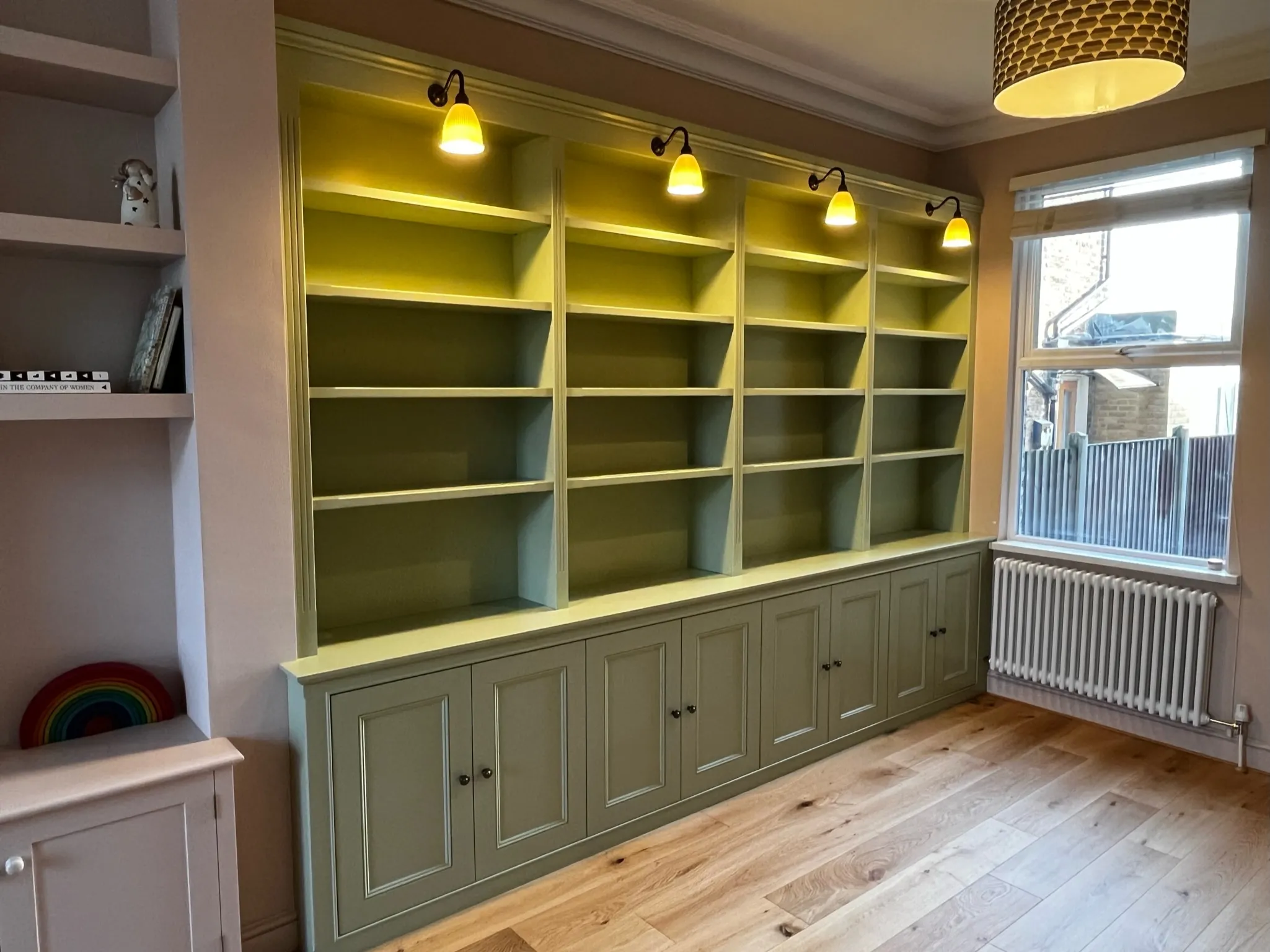
Yes — this is one of our most popular alcove configurations. The alcove bookcase fills the full height of the alcove with adjustable open shelves above a pair of closed cupboard doors at the base, hiding clutter while keeping books and objects on display. We can leave the back as original wall or add a painted back panel to lift book spines visually.
Get in Touch
Transform Your Space with Bespoke Carpentry
Create your ideal fitted furniture that's unique to you, lasts a lifetime, and is handmade by a local skilled joiner and carpenter.
Get a free consultation call to discuss your project.